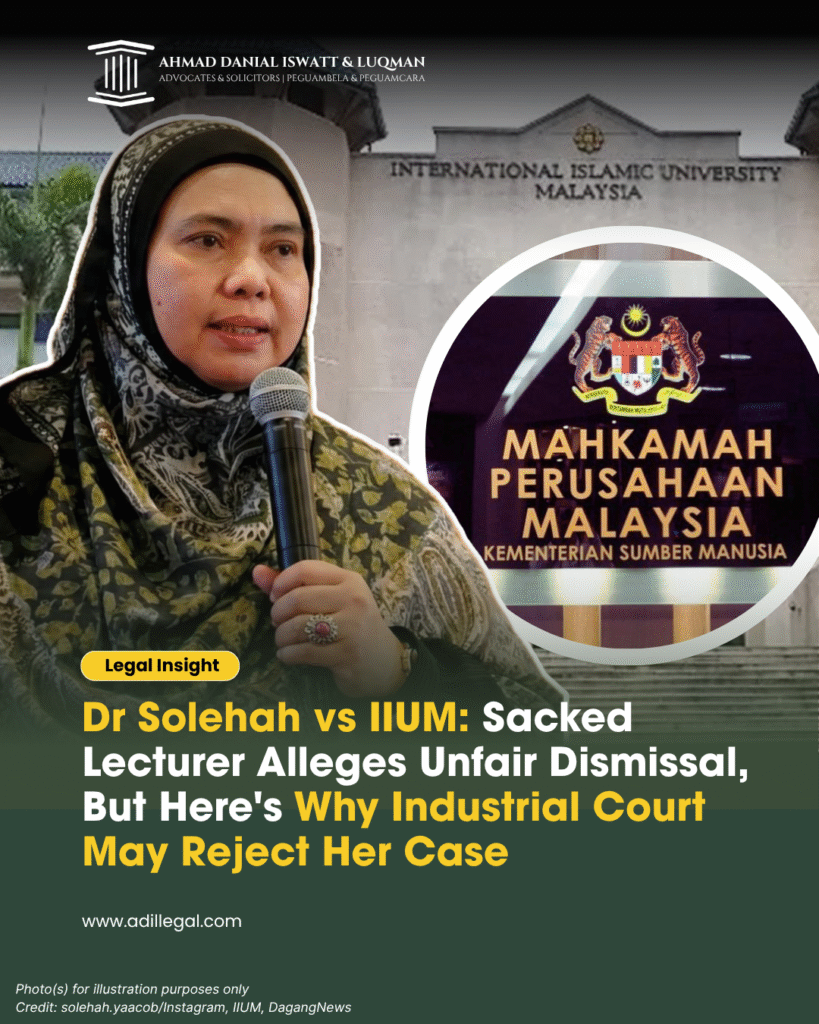
Dr Solehah vs IIUM: Sacked Lecturer Alleges Unfair Dismissal, But Here's Why Industrial Court May Reject Her Case
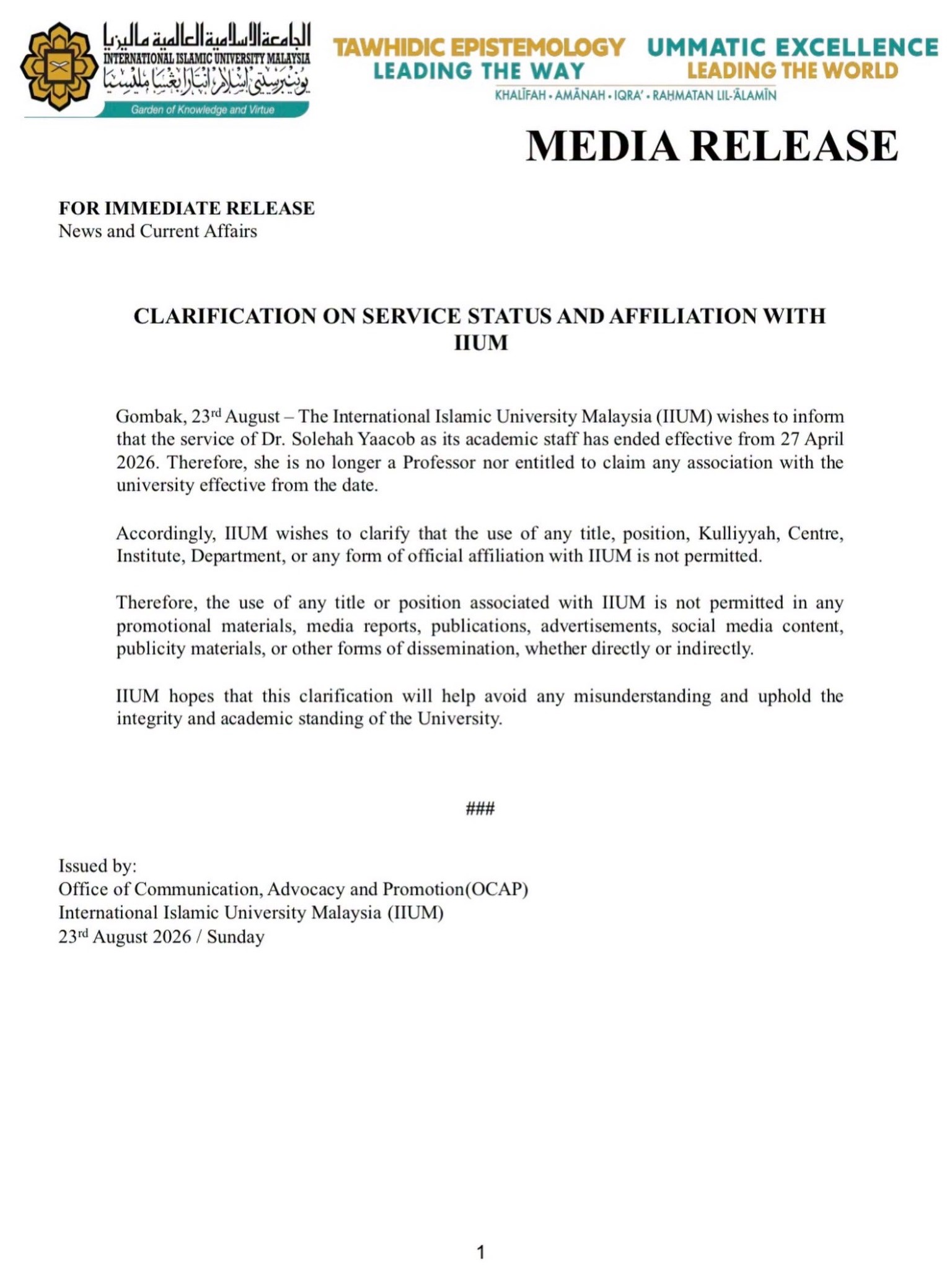
Controversial Malaysian lecturer Dr Solehah Yaacob made headlines recently after her now-former employer, the International Islamic University Malaysia (IIUM), announced on 23 August 2026 that her service as its academic staff has been terminated. In a statement, IIUM said that Dr Solehah is no longer a Professor, nor is she entitled to claim any association with the university, effective from 27 April 2026.
The university further clarified that Dr Solehah is also not permitted to use any title, position, Kulliyyah, Centre, Institute, Department, or any form of official affiliation with IIUM. This includes use in any promotional materials, media reports, publications, advertisements, social media content, publicity materials, or other forms of dissemination, whether directly or indirectly.
However, the embattled lecturer, who holds a doctorate in Arabic linguistics, is not going down without a fight. Immediately after IIUM made the public announcement, Dr Solehah told FMT that she would be challenging the termination and taking the university to the Industrial Court.
She further claimed that IIUM had dismissed her within 24 hours and that she was not allowed to appeal the decision. Dr Solehah added that IIUM offered to pay her the equivalent of six months’ salary, but she refused the offer.
However, can she actually take IIUM to the Industrial Court for the reported abrupt termination of her services? Read on as we delve into the relevant laws and regulations regarding unfair dismissal in Malaysia.
Unfair dismissal representation in Malaysia
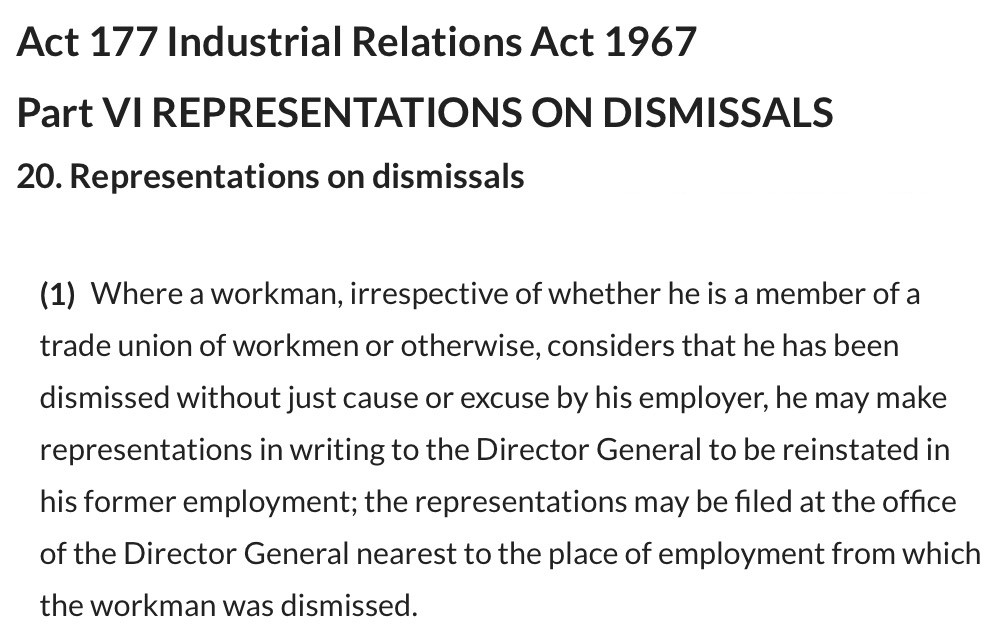
The framework for navigating unfair dismissal in Malaysia is governed under the Industrial Relations Act 1967 (IRA). Under Section 20 of the Act below, a former employee who considers their dismissal was made without just cause or excuse may seek remedies by making a written representation to the Director General of Industrial Relations (DGIR).
For context, Section 2 of the IRA defines ‘workman’ as follows:
Industrial Court has no jurisdiction over any government service or statutory body
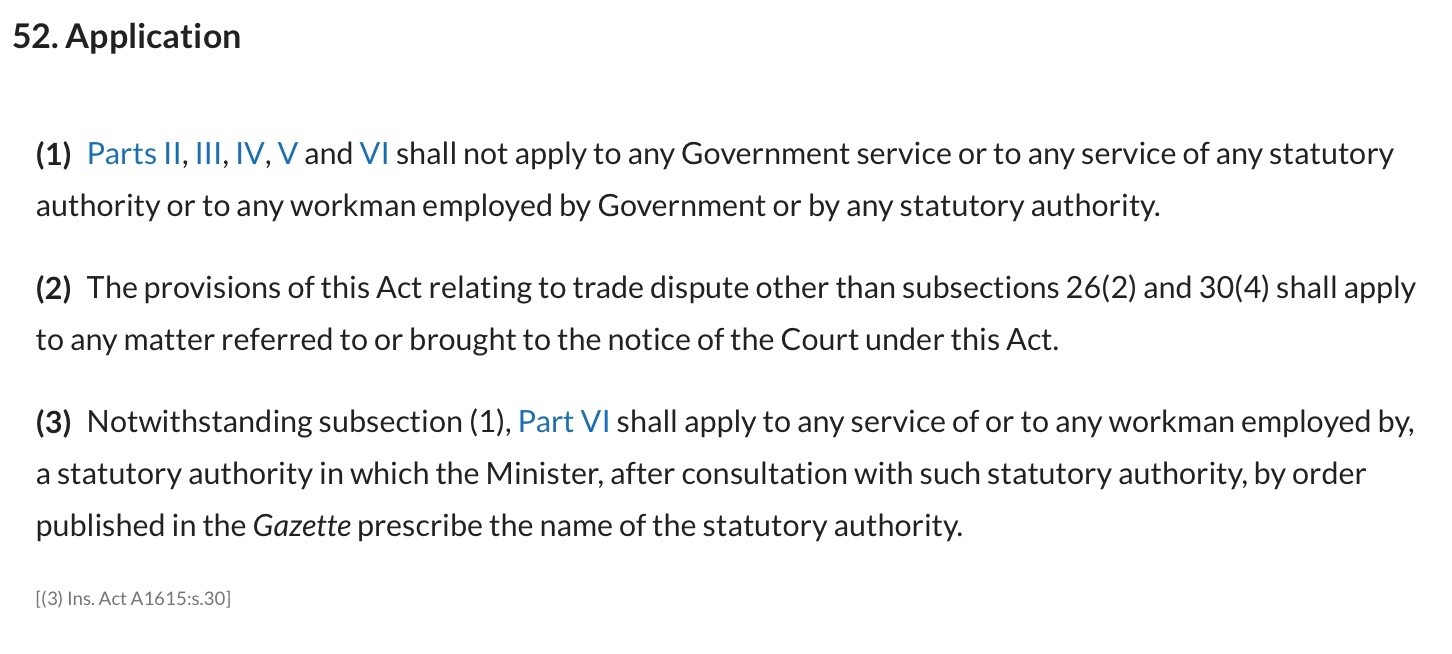
In Dr Solehah’s case, however, things get a bit tricky as her former employer is IIUM, a public university. This is because, under Section 52 of the IRA below, the Industrial Court has no jurisdiction to hear unfair dismissal representations against any government service or the service of any statutory authority, nor can it hear representations from public servants.
This is further complicated by the fact that while IIUM is a public university, it is not bound by Section 24D of the Universities and University Colleges Act 1971 (AUKU) below, which deems all university employees to be public servants.
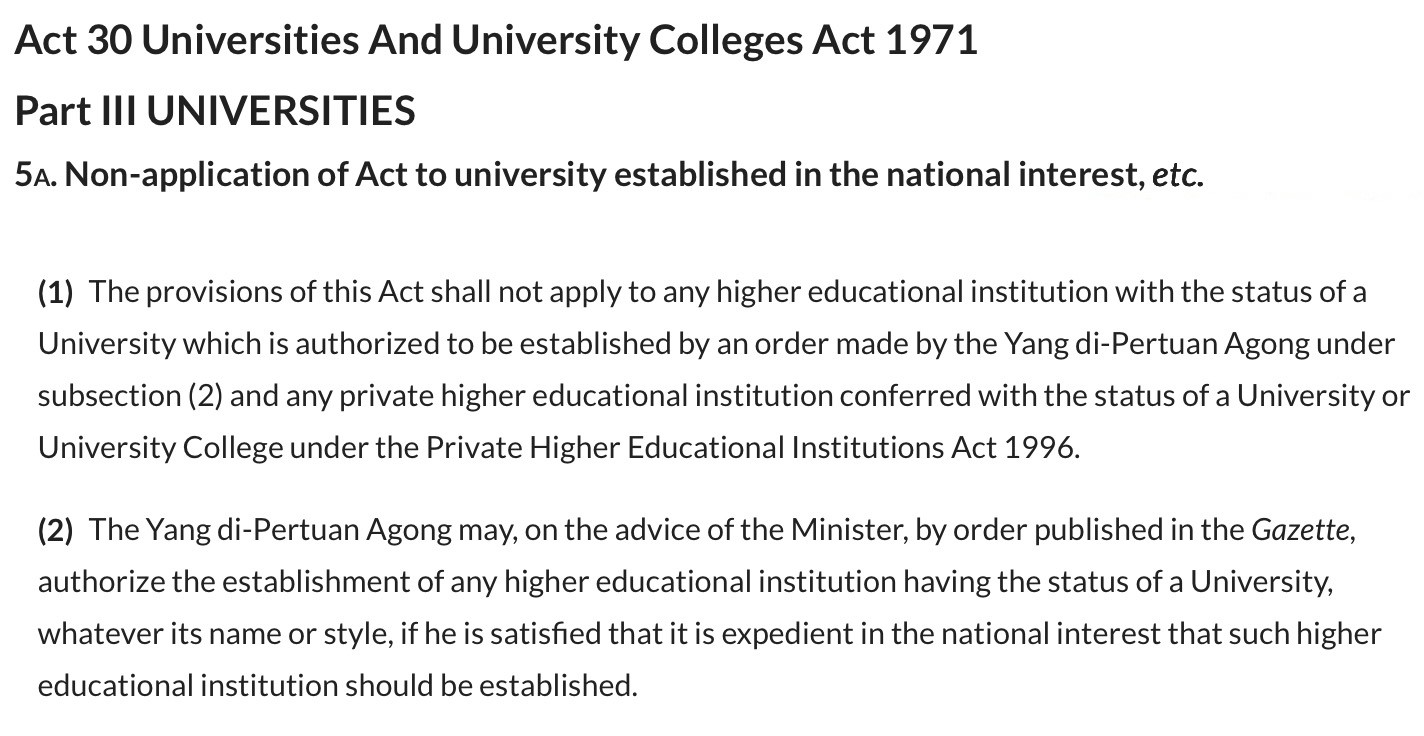
For context, IIUM was established under the International Islamic University, Malaysia (Establishment) Order 1983 [P.U.(A) 194/1983], which exempts the university from AUKU as per Section 5A of AUKU below.
Industrial Court must decide whether IIUM is a government service
Nevertheless, it can be argued that IIUM is a government service or statutory authority as per Section 52 of the IRA, based on the judgment of Institut Integriti Malaysia v Roziah bt Harun & Anor [2024] MLJU 2112. In that landmark case, the Court of Appeal ruled that the Industrial Court was correct to strike out a former employee’s dismissal representation against Institut Integriti Malaysia.
The court noted that although the institute was incorporated under the Companies Act 2016 as a company limited by guarantee, it constitutes a government service or statutory authority because it functions as an instrument of government. Crucially, the ruling establishes that an entity will be classified as such if its pith and substance is an instrumentality or agency of the government.
Circling back to Dr Solehah’s alleged unfair dismissal by IIUM, it is up to the Industrial Court to decide whether the university constitutes a government service and strike out the case, or rule otherwise and proceed with hearing the representation.
For more insights into the Malaysian legal system such as this, do make sure to follow us on Facebook and Instagram or visit our official website. You can also read our articles on the popular Malaysian news aggregator app Newswav here.