Fired without Valid Reason? How to Take Your Boss to Industrial Court & Win Your Job Back or Up to 2 Years' Backwages
Finding yourself suddenly out of work can be a deeply stressful and destabilising experience, especially if you feel the decision was abrupt, unjust, or completely blindsided you. In Malaysia, many employees assume that if a company observes their contractual notice period, management has absolute authority to end their employment.
However, this cannot be further from the truth. On the contrary, Malaysian employment laws provide robust safeguards to protect workers from arbitrary termination.
If you have been fired without a valid reason, you do not simply have to accept it and walk away. Understanding your legal rights and navigating the proper channels can help you challenge an unfair dismissal, secure justice, and hold employers accountable.
Read on as we delve into the relevant laws and safeguards against unfair dismissal in the country.
Employees cannot be dismissed without just cause or excuse
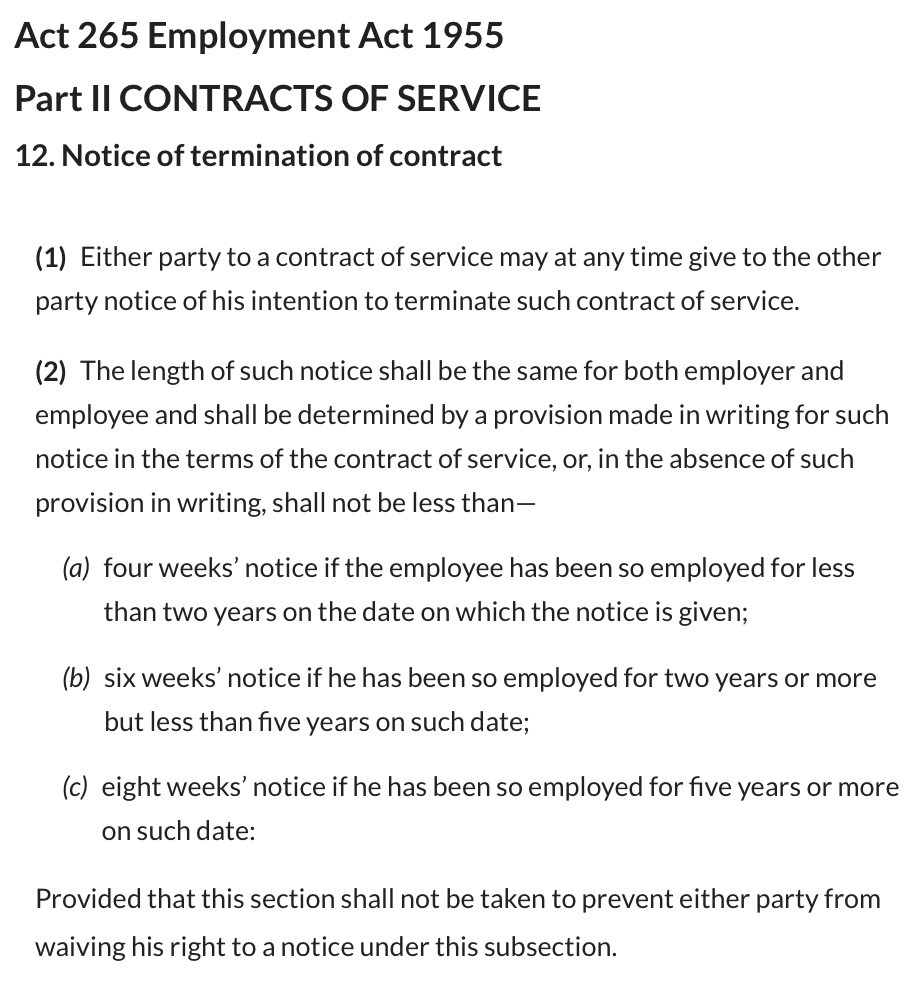
While Section 12(1) of the Employment Act 1955 below prescribes that both employers and employees may terminate an employment contract by giving notice, Malaysian courts have consistently held that termination based on contractual notice alone does not constitute a ‘just cause or excuse’.
Furthermore, Malaysia does not recognise the common-law principle of ‘termination simpliciter’ (ending an employee’s contract by giving standard notice without stating a specific reason, fault, or disciplinary cause). In the Federal Court case of Dr A Dutt v Assunta Hospital [1981] 1 MLJ 304, it was held that termination simpliciter without just cause or excuse empowers the Industrial Court to award compensation where reinstatement is not ordered.
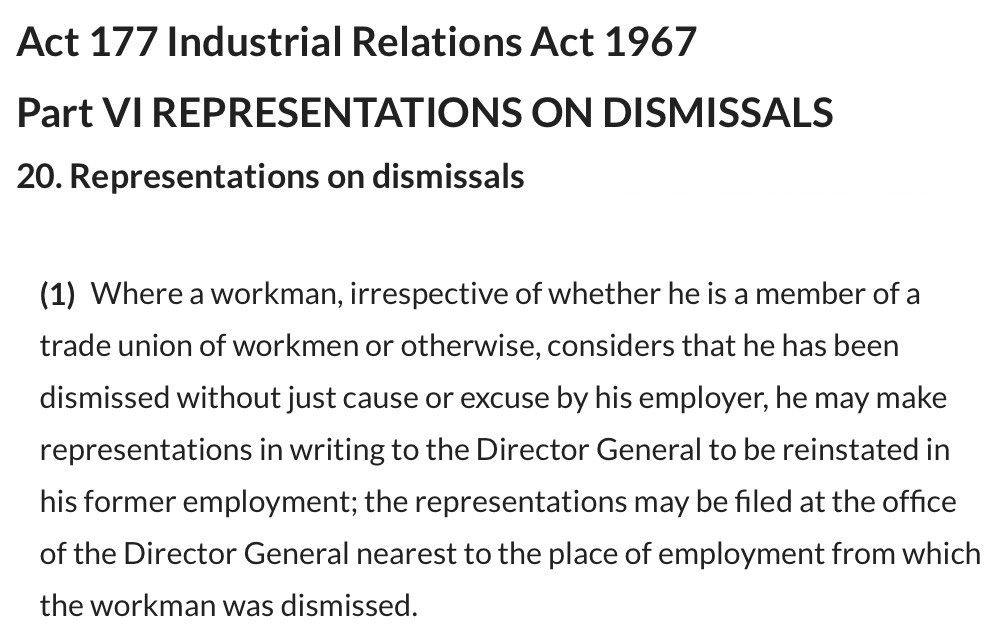
The framework for navigating unfair dismissal in Malaysia is governed under the Industrial Relations Act 1967 (IRA). Under Section 20 of the Act below, a former employee who considers their dismissal was made without just cause or excuse may seek remedies by making a written representation to the Director General of Industrial Relations (DGIR).
For context, Section 2 of the IRA defines ‘workman’ as follows:
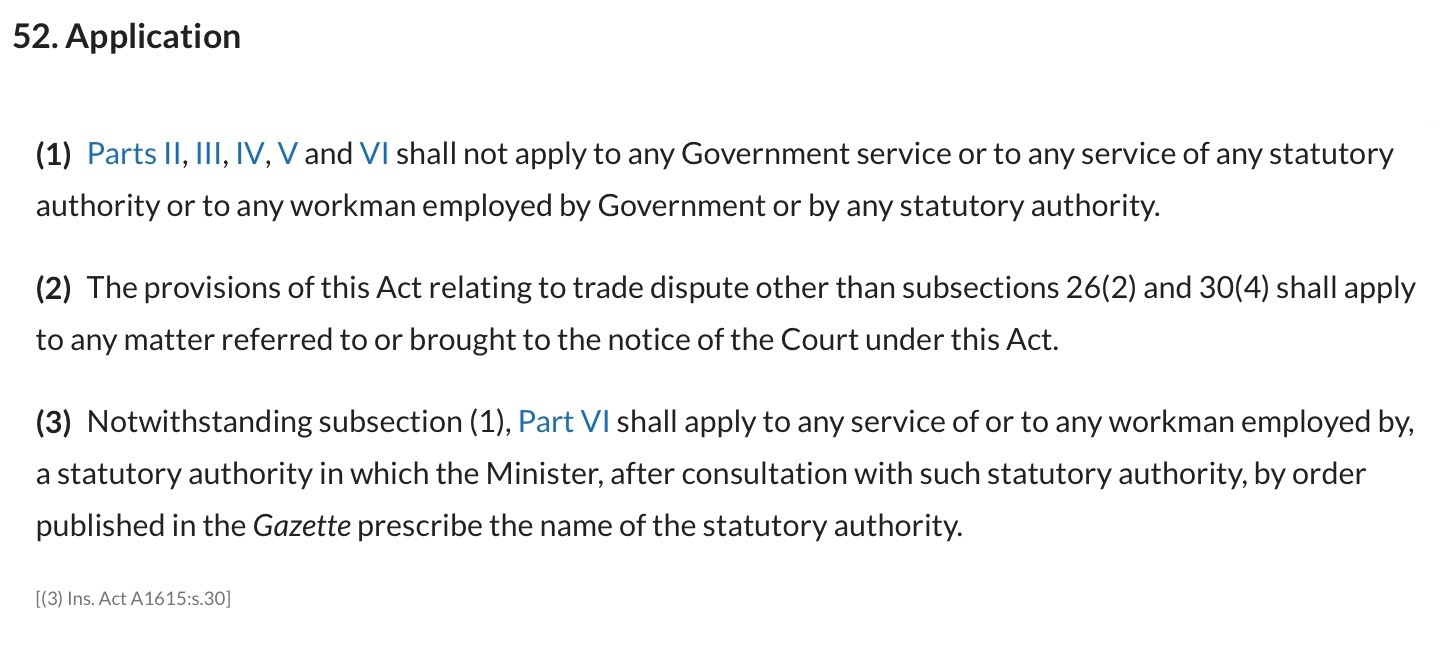
With that in mind, do note that an unfair dismissal representation cannot be brought by a public servant or against any government service or the service of any statutory authority. This is prescribed by Section 52 of the IRA below:
Steps in challenging unfair dismissal in Malaysia
1. Filing a representation
Under Section 20(1A) of the IRA, the representation must be filed within 60 days of the dismissal or during the period of notice of the dismissal, or it will not be entertained.
The official Department of Industrial Relations Malaysia (DIRM) website clarified that the representation can be submitted online through the IRIS system.
Do note that when filing a representation, employees must primarily seek reinstatement as a remedy. Claims for compensation alone are not accepted at this stage and may cause the Industrial Court to decline jurisdiction over the dispute.
2. Conciliation
As per Section 20(2) of the IRA above, the Director General of Industrial Relations (DGIR) will then arrange and facilitate a conciliation meeting between the employer and employee using the Alternative Dispute Resolution (ADR) method. According to the DIRM website, the department will set the date for a conciliation meeting where employers and employees will be called to attend a face-to-face conciliation meeting. Under certain circumstances, an online conciliation meeting is also possible.
If the parties reach a settlement, DIRM will prepare a Memorandum of Agreement (MOA) for both parties to endorse. Upon full compliance with the MOA terms, the case is deemed settled and closed. Alternatively, if the worker fails to attend three scheduled conciliation meetings, the representation may be treated as withdrawn.
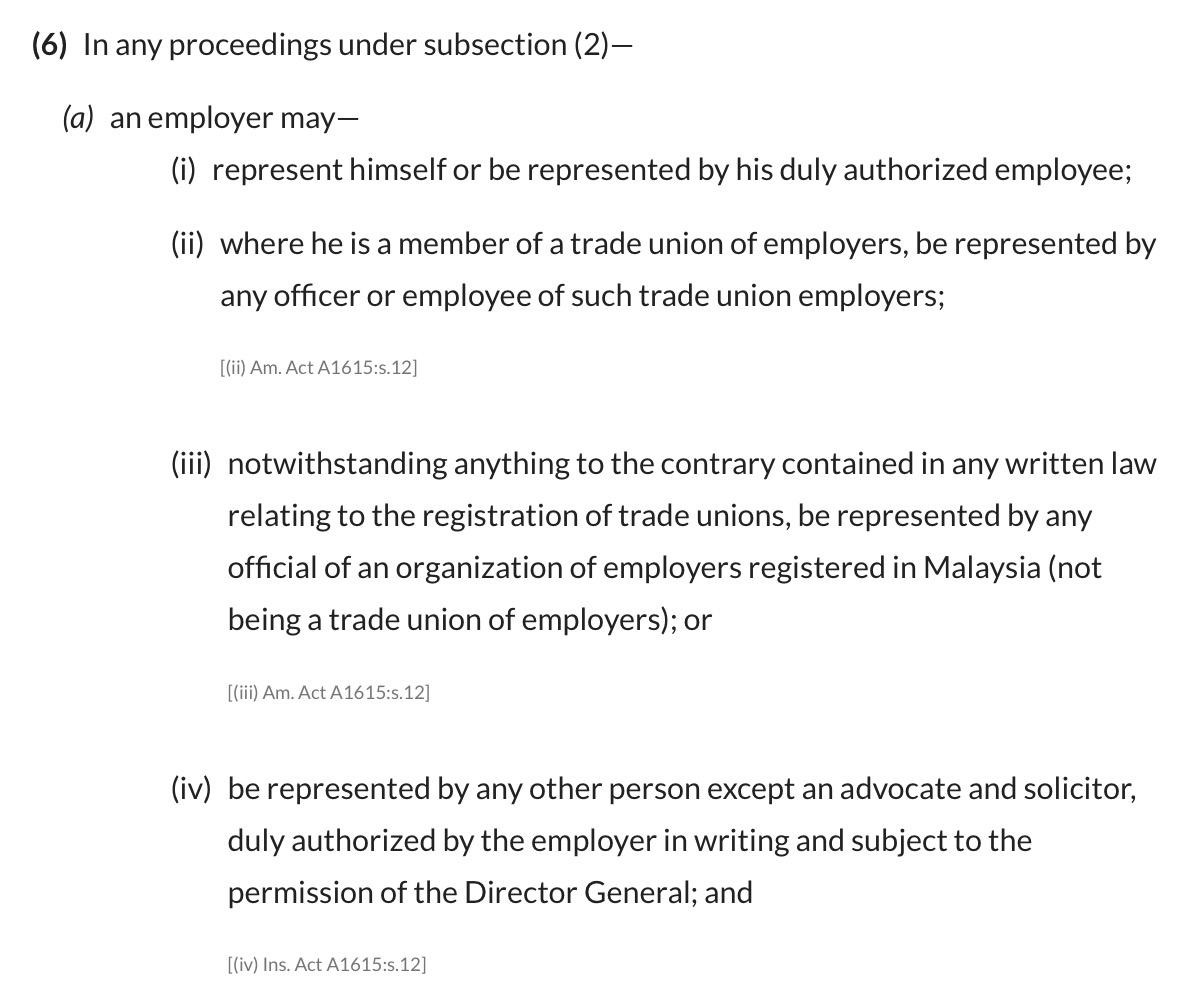
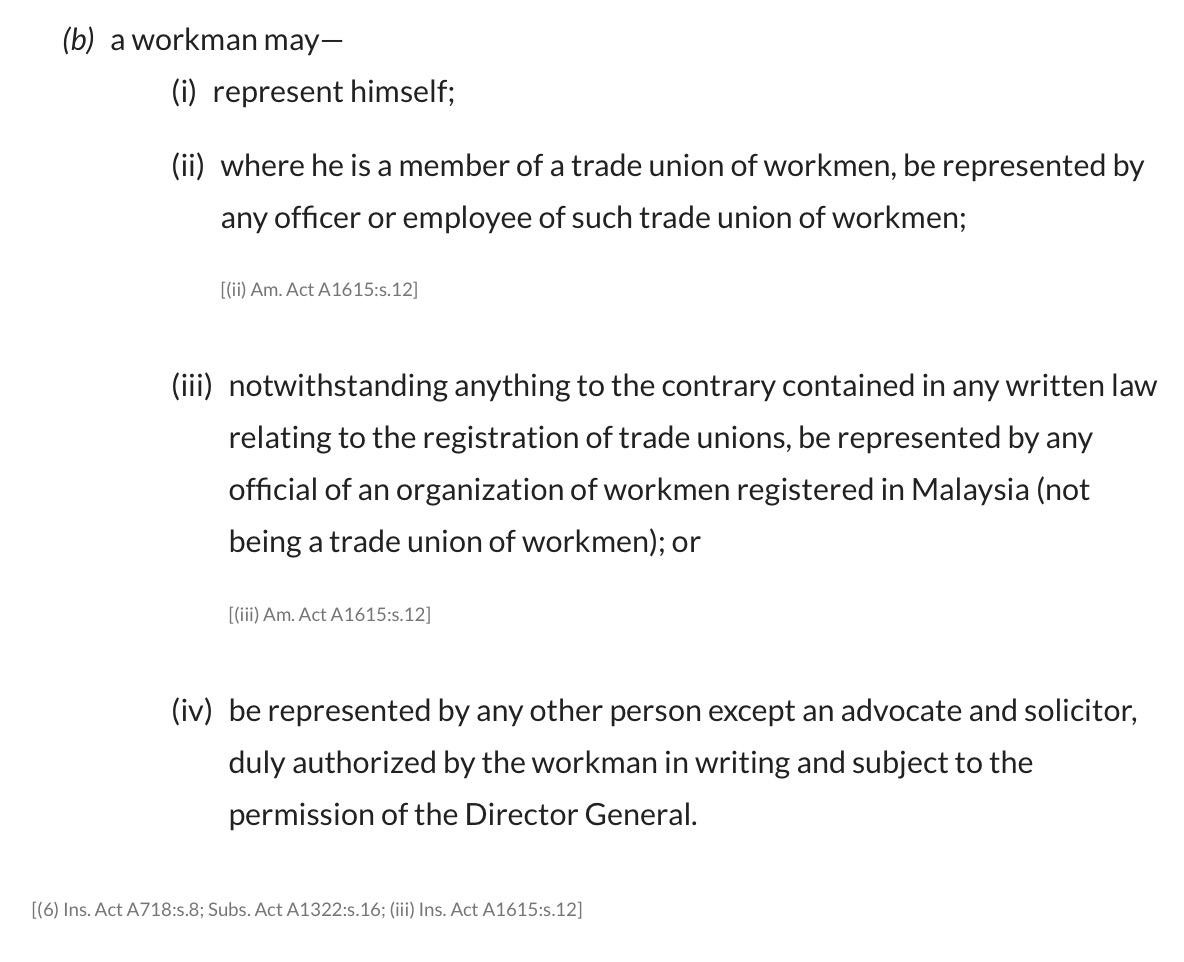
According to Section 20(6) of the IRA, legal representation is not permitted during conciliation. Both the employee and employer may appear personally or through authorised non-legal representatives.
3. Referral to the Industrial Court
However, should conciliation fail or there be no likelihood of the representation being settled, the DGIR shall refer the representation to the Industrial Court for an award. This is pursuant to Section 20(3) of the IRA.
Upon referral, the Industrial Court will issue a Notice of Mention of Case outlining key details, including hearing dates, filing instructions, and other pre-hearing directives. Unlike conciliation, legal representation is permitted before the Industrial Court.
At the hearing, the employer bears the burden of proving that the dismissal was for ‘just cause or excuse’ and that due process was observed.
4. Award by the Industrial Court
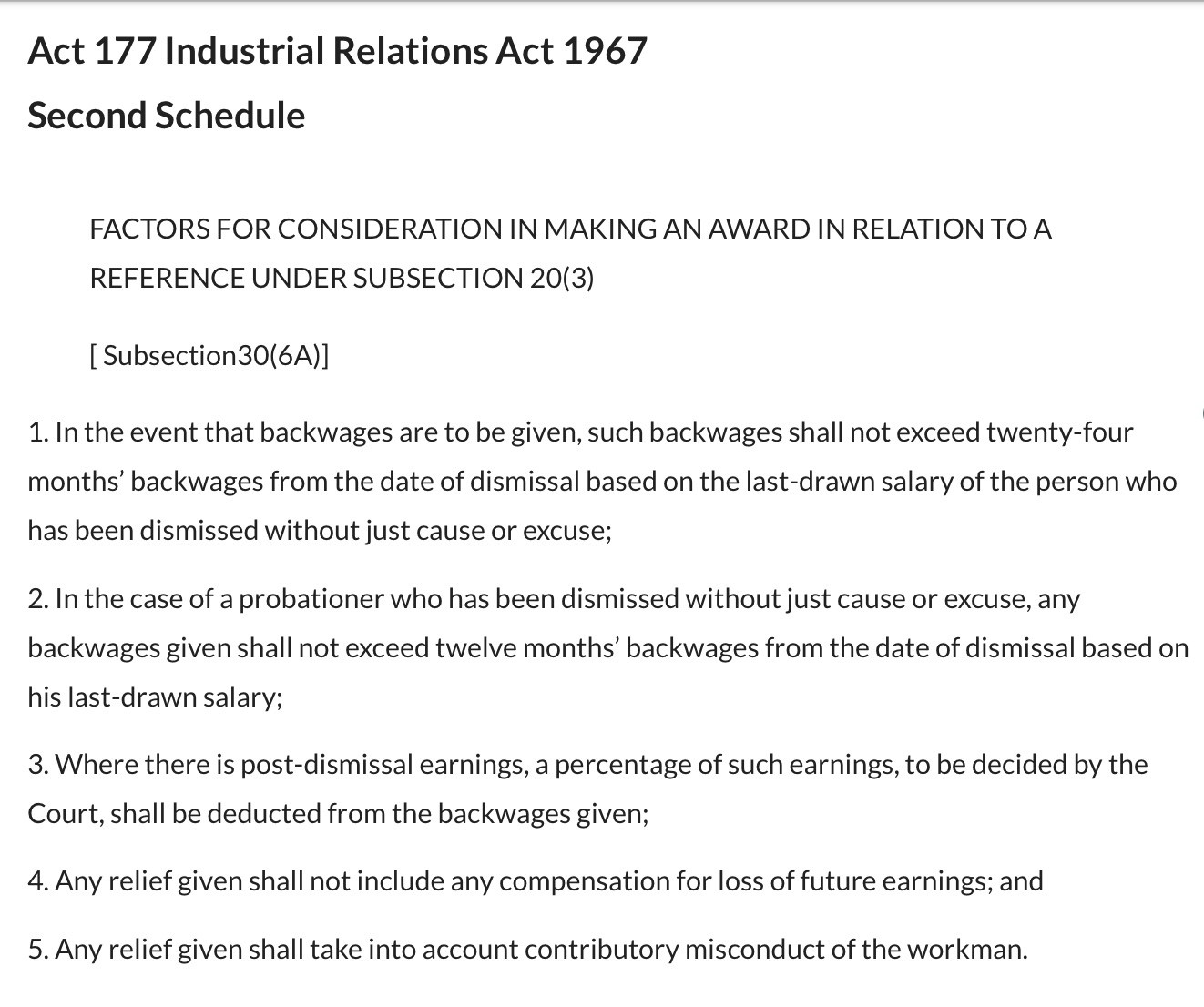
The decision of the Industrial Court is issued in the form of an award that binds both disputing parties. As per the Second Schedule of the IRA, if the employee succeeds in their claim, the Industrial Court may award:
Reinstatement or compensation in lieu of reinstatement
which is usually calculated at one month’s salary per completed year of service; and/or
Backwages
(typically capped at 24 months for permanent employees) calculated from the date of dismissal to the date of the award.
Any party dissatisfied with the Industrial Court’s decision may appeal to the High Court within 14 days of receiving the award.
Know your rights as an employee
Navigating the aftermath of an unfair dismissal can feel intimidating, but Malaysia’s industrial relations framework gives workers a structured path to fight back. Whether your goal is to return to your role through reinstatement or secure rightful compensation, taking your employer to the Industrial Court ensures that your case is evaluated fairly under the law.
If you find yourself facing an unjust exit, knowing your rights is your strongest first step toward setting things right.
For more insights into the Malaysian legal system such as this, do make sure to follow us on Facebook and Instagram or visit our official website. You can also read our articles on the popular Malaysian news aggregator app Newswav here.