
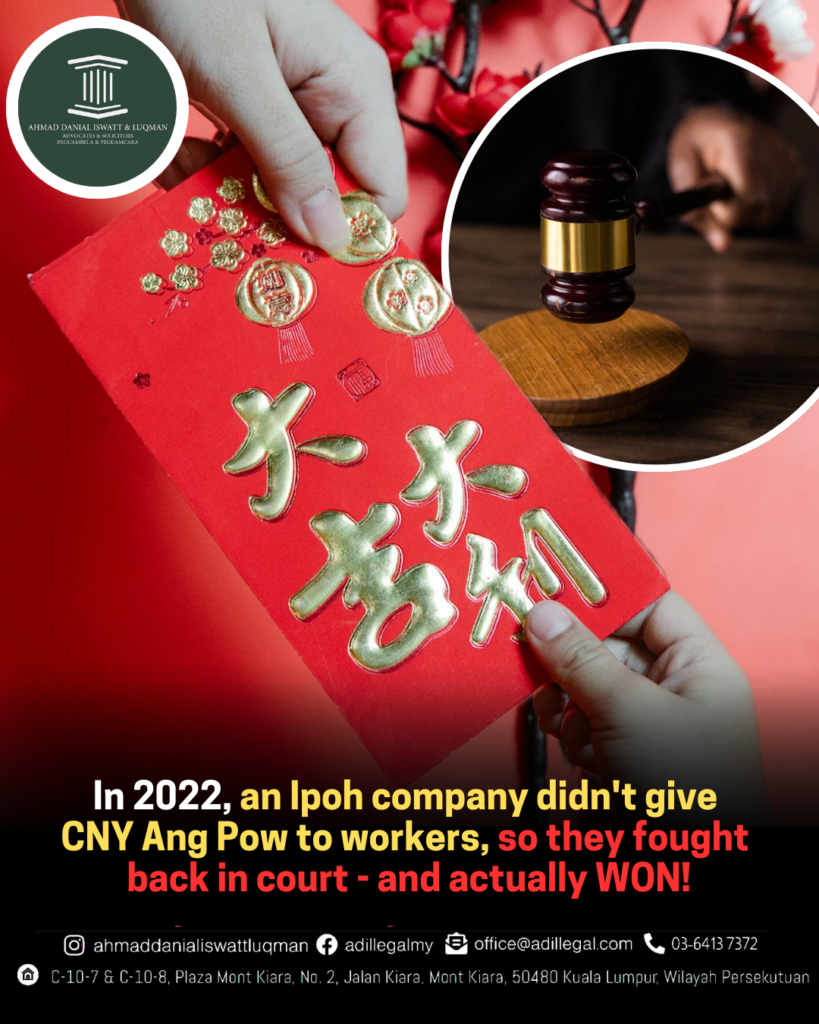
In 2022, an Ipoh company didn't give CNY Ang Pow to workers, so they fought back in court - and actually WON!
With a legacy spanning over three millennia, the Lunar New Year, commonly known in Malaysia as Chinese New Year (CNY), stands as a pillar of heritage for over 6.9 million Chinese Malaysians. As the nation’s second-largest ethnic group, their celebration is a vibrant highlight of our national calendar, marked by a unique local flair that defines our diverse country.
As we enter the Year of the Horse this CNY2026, one tradition synonymous with the festivities that has stood the test of time is the giving of the red money packets or ‘Ang Pow.’ In fact, the giving of Ang Pows has even assimilated into other cultures, as can be seen by the giving of green ‘Raya’ money envelopes during Hari Raya Aidilfitri.
In the corporate world, it’s also customary for employers, particularly those of Chinese descent, to give ‘Ang Pow’ to their employees as a gesture of prosperity and thanks during the season. But what happens when a decades-old company tradition is suddenly stopped?
For the workers of Tasek Corporation Berhad (hereinafter referred to as “the Company”), a major cement manufacturer in Ipoh, Perak, this wasn’t just a hypothetical question; it became a legal battle at the Industrial Court.
Here’s everything you should know about this intriguing case:
Kesatuan Pekerja-Pekerja Perusahaan Simen Semenanjung Malaysia v Tasek Corporation Bhd [2025] ILJU 60
The Company is a prominent manufacturer of both bag and bulk cement. Because cement kilns and production lines often require continuous operation, the plant runs 24/7, including during major public holidays such as CNY.
The dispute arose under the 16th Collective Agreement (CA), covering the period from July 2019 to June 2022. Following the CNY period in 2022, the workers, represented by Kesatuan Pekerja-Pekerja Perusahaan Simen Semenanjung Malaysia (hereinafter referred to as “Union”), raised a grievance alleging that the Company had failed to pay the “Special Ang Pow” to employees who performed overtime work during the festivities.

The Union’s arguments
The Union stated that in the 1960s, the Company’s plant was predominantly dominated by Chinese employees. To encourage staff to work during CNY, a special Ang Pow payment was introduced, as it had traditionally been the Company’s practice to pay a special Ang Pow to employees who performed overtime on CNY’s eve.
The Union argued that employees working during the Chinese New Year sacrifice their reunion dinner, the most significant event in the cultural calendar, to ensure the Company’s productivity remains uninterrupted. The Union contended that the payment was an existing benefit and that it was unfair and unjustified to unilaterally withdraw it.
Their arguments included:
Independent circular
The Union relied on a 1960s document titled “Special Ang Pow Payment for Working During Chinese New Year,” which they identified as the Company’s independent circular. They argued that the mode of payment was indoctrinated in this circular and constituted a binding factor pertaining to the special Ang Pow payment.
Reasonable expectations
The Union further argued that the Company was bound by its prior conduct and the reasonable expectations it had created among its workers. They claimed the Company had indeed waived its discretionary power, which precluded it from revoking established benefits.
Industrial harmony
The Union stated that the withdrawal of these established benefits would not enhance industrial harmony and characterised the action as an act of victimisation that uprooted the livelihood of employees.
The Company’s counter-arguments
In response, the Company countered in the Industrial Court that the Union’s claim was unfounded and without basis. Their defence focused on the following:
No contractual obligation
The Company emphasised that the payment was not contained in the 16th CA, Company policy, Employees’ Handbook, or Letter of Exchange. They added that there was no valid, legal, and binding agreement obligating the Company to pay the special Ang Pow.
Gratuitous payment
Describing the Ang Pow as a gratuitous payment, a conciliatory gift, and a token of gratitude, the Company argued that the granting of such benefits is based on the use of absolute discretion by management and is not a contractual right.
Formula/calculation document
Moreover, the Company denied that the 1960s document was a circular, claiming it was merely a document showing the formula/calculation and history of payments. They also argued that it contained no words or sentences that obliged the Company to make the payment.
Prerogative right
The Company asserted its prerogative right to waive, withdraw, or discontinue the payment, as the failure to pay is not mandatory under any legal clause or provision of existing laws.
The Industrial Court’s Decision
In a majority decision of 2:1, the Industrial Court evaluated the dispute by balancing the Company’s discretionary rights against the substantial merits of the case.
The Court reaffirmed that benefits like bonuses and Ang Pows are generally at the absolute discretion of the company. It ruled that the Company does not violate terms of employment when it exercises its prerogative right to discontinue a benefit that is not legally mandatory or provided for in the contract of employment.
However, despite the lack of a contractual mandate, the Court took into account the hard work of the employees to help the Company thrive as a leader in the industry, as well as the festive spirit of the celebration. To ensure industrial harmony, the Court found it “coincide and appropriate” for the Company to pay the special Ang Pow for the year 2022 as an expression of appreciation, concern, and gratitude.
Award and limitations
Guided by Section 30(5) of the Industrial Relations Act 1967 to “act according to equity, good conscience and the substantial merits of the case without regard to technicalities and legal form,” the Court held:
- The Union’s claim for the 2022 payment was allowed, but strictly subject to and limited to the year 2022 only
- The Court explicitly clarified that, as a matter of sole discretion and prerogative, the Company has the right to, and may, discontinue this benefit in the future
This decision reflects the Court’s effort to maintain industrial harmony by honouring established expectations for a specific period while upholding the employer’s long-term prerogative regarding discretionary payments.
While this decision confirms that bonus payments are generally a matter of management discretion, it also establishes that such discretion is not absolute. Once management has defined clear terms and established specific goalposts for a bonus, they are expected to honour those commitments.
Consequently, employers must exercise extreme caution when drafting bonus schemes. Once a bonus policy is officially released, it cannot be easily revoked, as employees will have performed their duties in reliance on it for that year. Therefore, before introducing any bonus scheme, an employer must be fully prepared to commit to its implementation.

For more insights into the Malaysian legal system such as this, do make sure to follow us on Facebook and Instagram or visit our official website. You can also read our articles on the popular Malaysian news aggregator app Newswav here.