
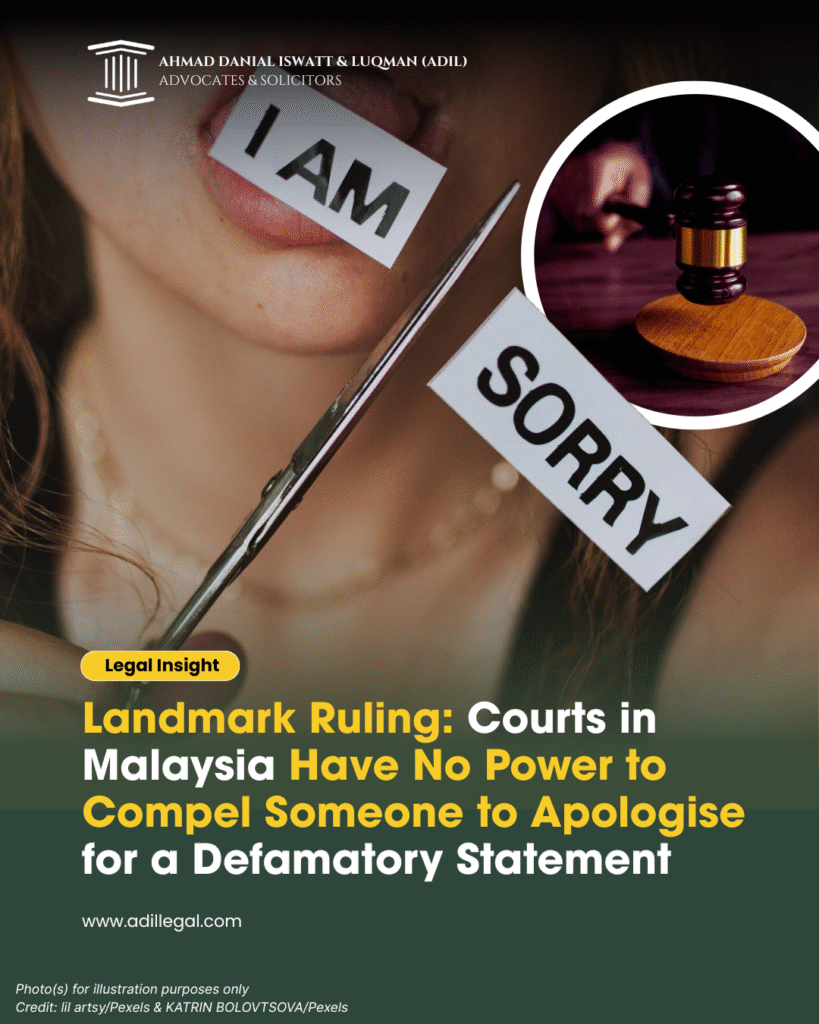
Landmark Ruling: Courts in Malaysia Have No Power to Compel Someone to Apologise for a Defamatory Statement
Over the past few months, Malaysia has seen the resolution of several high-profile defamation cases involving prominent political figures. On 20 April, Jasin Member of Parliament (MP) Zulkifli Ismail and the PAS mouthpiece Harakah issued a public apology to Education Minister Fadhlina Sidek over a defamatory statement dating back to 2023.
A fortnight later, on 4 May, Bersatu politician and activist Badrul Hisham, better known as Chegubard, similarly issued a public apology to former Minister of Natural Resources, Energy and Climate Change Nik Nazmi Nik Ahmad for defamatory allegations against him in 2023. May also marked the conclusion of the defamation suit between former Health Minister Khairy Jamaluddin and UMNO Sungai Besar chief Datuk Seri Jamal Md Yunos, concluding with the latter issuing a public apology for defamatory remarks made in 2022.
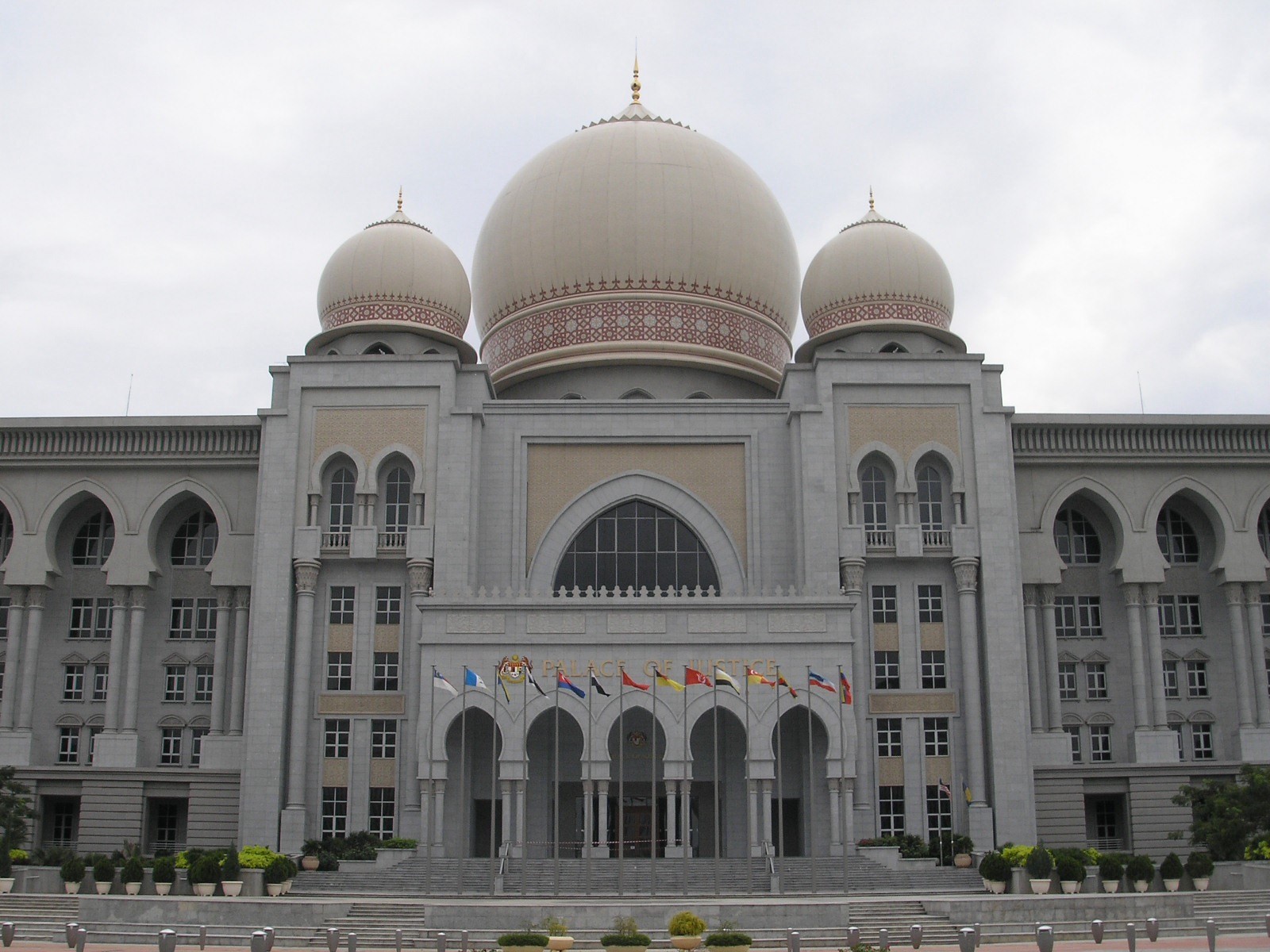
It does not take a legal professional to see the similarities in these cases, or defamation suits in general. In defamation suits, it is very common for defendants to issue apologies as part of settlements where the parties agree to resolve the dispute.
However, did you know that courts in Malaysia actually have no power to compel a defendant to apologise in a defamation suit?
A recent landmark ruling by the Court of Appeal affirmed this, but what does this actually mean? Here is everything you should know.
The Landmark Case
The landmark ruling was delivered at the Court of Appeal in the case of Tan Sing How & 2 Ors v Ng Ze Xuan [2026] LCR 34 (CA) on 25 May 2026. The case was heard before a three-member Court of Appeal panel chaired by Datuk Mohamed Zaini bin Mazlan, JCA, sitting alongside Dato’ Ong Chee Kwan, JCA, and Tuan Muniandy a/l Kannyappan, JCA.
Justice Ong Chee Kwan delivered the judgment of the court, with the hearing involving an appeal by Tan Sing How, Lai Phui Khae, and Kalysta Sdn Bhd against a High Court decision that found them liable for defaming former General Agent Ng Ze Xuan, also known as Stella. The dispute arose from seven impugned statements published via WeChat groups, a Zoom meeting, and Instagram over a compressed period of eight days between 16 and 24 July 2021, alleging breaches of company policy, dishonesty, and misconduct.
The statements accused Stella of breaching company operational policies and directives, undermining Kalysta’s business interests, dishonesty, and other misconduct regarding a separate online business known as “Everyday” and a controversy involving a local influencer dubbed the “YBB Incident”. The High Court had awarded Stella RM600,000.00 in damages and ordered the appellants to publish an apology.
However, the Court of Appeal allowed the appeal on the quantum of damages, reducing the cumulative sums of RM600,000.00 to a single global sum of RM100,000.00 to be paid jointly and severally by the Appellants. Additionally, the Court of Appeal set aside the order for an apology to be issued, which circles us back to the subject matter at hand. In the main judgment, the court held that there is no jurisdiction to order the publication of an apology.
Courts Cannot Compel Apologies

In delivering the main judgment, Justice Dato’ Ong Chee Kwan asserted that there is no recognised relief under the common law or in the Defamation Act 1957 empowering the court to compel a defendant to publish an apology. The court emphasised that a compelled apology is “really useless” when ordered against a defendant’s willingness, introducing severe practical difficulties by requiring the judiciary to constantly supervise its tone, wording, and prominence. The learned judge asserted:
“An apology, by its nature, is an expression of contrition and a matter of volition. To compel a party to apologise would be to require the court to dictate the content of speech, and supervise its adequacy and sincerity, which in our view are matters that lie beyond the proper province of judicial determination…”
“There is also no provision under the Defamation Act 1957 that empowers the High Court to grant such an order or compel a defendant to render an apology. Under the Defamation Act 1957, the remedies expressly contemplated are confined to damages and are notably silent on any power to compel a defendant to issue an apology. Where Parliament has legislated comprehensively in respect of defamation remedies and omitted apology as a form of relief, the Court should not supplement the legislative schemes of remedies.”
To support this position, the court relied on a robust framework of legal authorities, ruling that where common law or Parliament has comprehensively legislated a specific scheme of remedies, the judiciary cannot fashion novel ones. The primary legal authorities and precedents cited by the court include:
- Credit Guarantee Corp Malaysia Bhd v SSN Medical Products Sdn Bhd [2017] (Malaysian Court of Appeal) – Establishing that an apology by its very nature must be voluntary and cannot be compelled by judicial order
- Chin Bay Ching v Merchant Ventures Pte Ltd [2005] (Singapore Court of Appeal) – Distinguishing between a court’s valid power to compel a withdrawal or correction versus an impermissible order to compel an apology
- Lim Guan Eng v Datuk Tan Teik Cheng & Anor [2023] & Chow Kon Yeow v Tan Sri Dato’ Tan Kok Ping [2025] (Malaysian High Courts) – Confirming that an apology order should be declined if the defendant shows no willingness to apologise
- Excel Golf Pte Ltd v Allied Domecq Spirits & Wine (Singapore) Ltd [2003] – Referencing established treatises like Gatley on Libel and Slander to affirm that courts do not possess the power to grant remedies that are not legally available
- Summertime Holdings Pty Ltd v Environmental Defender’s Office Ltd [1998] (New South Wales Supreme Court) – Holding that the common law takes the presence or absence of a voluntary apology into account for damages, but does not compel them
- Wilkinson v Barking Corporation [1948] (UK Court of Appeal) & Pasmore v Oswaldtwistle U.D.C. (UK House of Lords) – Providing the foundational statutory interpretation rule that when a statute provides a specific remedy, a party must resort to that remedy alone
Ultimately, the Court of Appeal concluded that a plaintiff’s right to the vindication of their reputation is fully and adequately satisfied by an award of damages and the written judgment itself, which carries the formal, authoritative weight of the court.
Courts May Record Consent Judgments That Incorporate Apologies
In a supporting judgment, Justice Tuan Muniandy a/l Kannyappan agreed that the High Court’s scripted apology could not stand, but stated that it was inaccurate to assert that superior courts suffer from an absolute jurisdictional bar over apologies in defamation cases. While concurring with the main ruling, he clarified that the court’s boundaries are not so rigidly constrained by the statutory silence of the Defamation Act 1957, noting that as a superior court of unlimited jurisdiction, it possesses an “inherent jurisdiction to prevent injustice and to craft remedies that achieve complete equal justice between the parties.”
The learned judge drew a clear distinction between an adversarial context where a remedy is forced after a trial, and a consensus-driven context like mediation. When a settlement is reached, the court routinely records a consent judgment, preserving the spirit of volition because the defaming party chooses the apology as a “pragmatic legal and commercial trade-off to conclude litigation,” meaning the court “does not run afoul of the sincerity dilemma.”

Furthermore, Justice Muniandy emphasised the realities of modern communication, noting that when a defamatory campaign is carried out entirely within closed digital networks. such as the WeChat and Instagram groups utilised by the Appellants, a formal written judgment confined to legal journals rarely reaches the original audience. Asserting that “an internet-based defamation requires an internet-based remedy,” he explained that the court can utilise its inherent power to match the true nature of the harm, provided the order is structured properly.
As the honourable judge observed:
“To resolve the practical difficulties of supervising emotional speech, any order made pursuant to the inherent jurisdiction of the court must be structured not as a command to express a subjective feeling of regret, but as a mandatory command to state an objective fact. The court will not force a party to say they are ‘sorry’, but they can be legally compelled to declare what is true.”
To circumvent the quagmire of forced remorse, Justice Muniandy explained that the scripted apology can be substituted with a “Mandatory Order for Rectification and Factual Withdrawal under the court’s inherent jurisdiction.” He concluded that such an order acts as a mechanical enforcement of the truth, entirely analogous to forcing a judgment debtor to pay a civil debt, where “compliance with this order requires no verification of the heart; it requires only verification of the text.”
In other words, while the courts have no power to compel a defendant to publish a subjective apology after a full trial, apologies can seamlessly form part of voluntary settlements where parties agree to resolve disputes via recorded consent judgments. Moreover, while courts will not force a party to say they are sorry, they can be legally compelled to declare what is objectively true.
For more insights into the Malaysian legal system such as this, do make sure to follow us on Facebook and Instagram or visit our official website. You can also read our articles on the popular Malaysian news aggregator app Newswav here.