
Parents Now Legally Liable for Children’s Acts of Bullying as Malaysia Introduces World's First Anti-Bullying Tribunal
Malaysia officially made history with the full enforcement of the Anti-Bullying Act 2026 (Act 876) on 16 June 2026. The landmark law establishes the world’s first Anti-Bullying Tribunal, a dedicated quasi-judicial body designed to handle cases outside the traditional court system.
This new avenue aims to provide a faster, more accessible, and child-friendly route to justice for the country’s population of more than nine million children, overcoming systemic bottlenecks in regular courts where civil bullying lawsuits have historically dragged on for up to nine years.
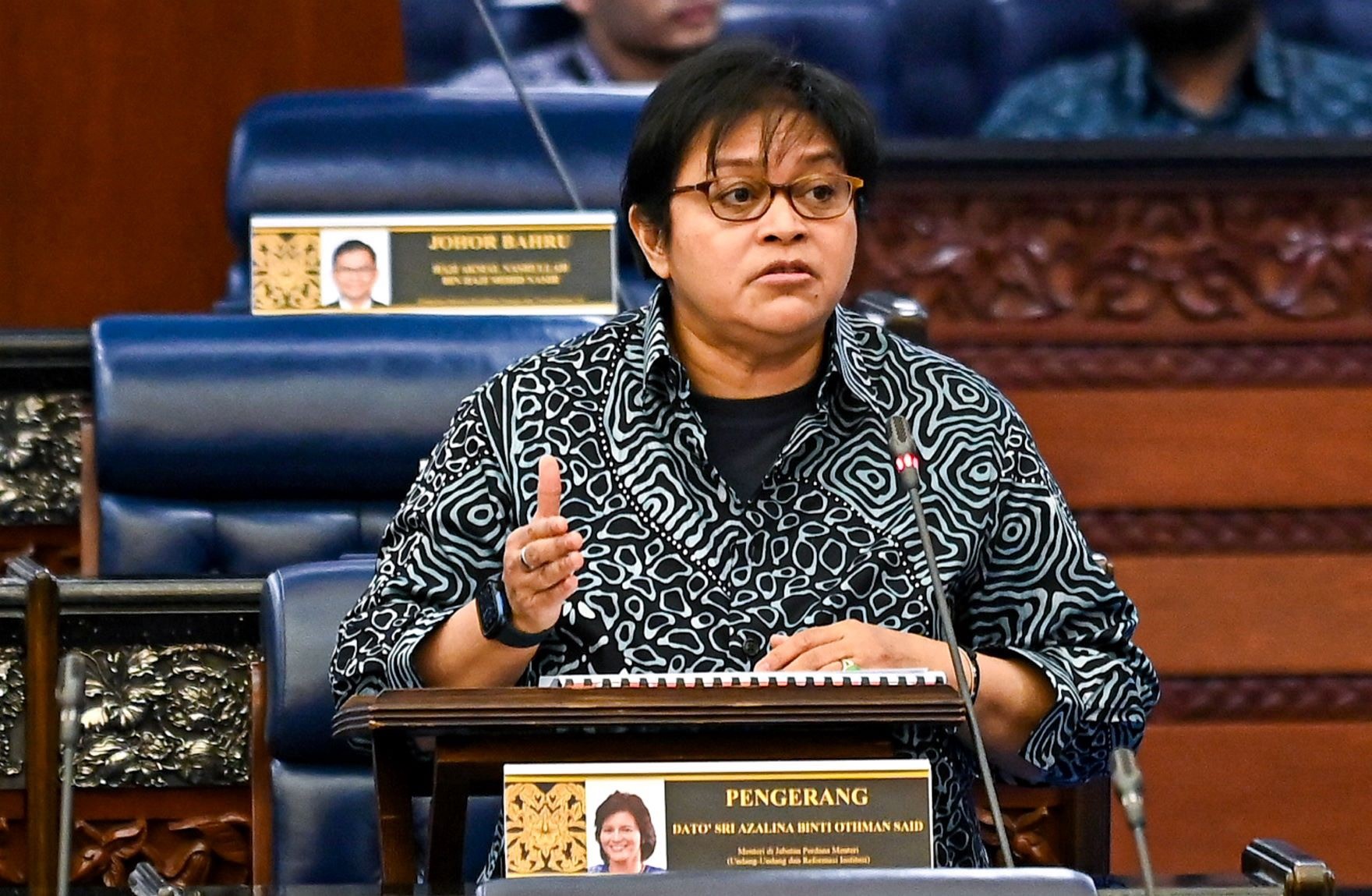
Highlighting the historic milestone, the Minister in the Prime Minister’s Department (Law and Institutional Reform), Datuk Seri Azalina Othman Said, was quoted by BERNAMA as saying:
“No other country has such a tribunal. There are sexual harassment tribunals, but an Anti-Bullying Tribunal has never been established before. The MADANI Government is fully aware that we cannot allow a culture of bullying to spread unchecked.”
Notably, Act 876 introduces strict parental accountability into the legal process by holding parents or guardians jointly liable if a minor is found responsible for bullying. Azalina added that this framework differs from ordinary criminal cases by placing accountability beyond just the individual offender. “Under the Anti-Bullying Act, we have included clauses on responsibility. Issues involving the payment of fines and other penalties will also bind the family. We have transferred liability, or joint liability, to the family as well,” she revealed.
Indeed, Act 876 operates on a restorative approach to protect and help the victim heal, while working alongside the country’s separate criminal laws under the Penal Code. By establishing joint liability, both criminal liability and civil liability, the new framework ensures that financial penalties and compensation orders issued by the tribunal are legally binding on the parents or guardians of the perpetrator.
So, what does Act 876 entail, and how exactly does the Anti-Bullying Tribunal function? Let us tackle the subject matter below and see how the law is standing up to perpetrators.
What Counts as Bullying Under Act 876?
Placed under the oversight of the Legal Affairs Division (BHEUU) of the Prime Minister’s Department, Act 876 provides a firm legal definition of bullying so schools and families know exactly what is punishable. Under Section 3 of the Act, a case can be brought to the tribunal if a perpetrator targets a victim, causing real physical, psychological, or social harm. The law specifies that bullying involves any wilful act, whether committed repeatedly or in a single severe incident.
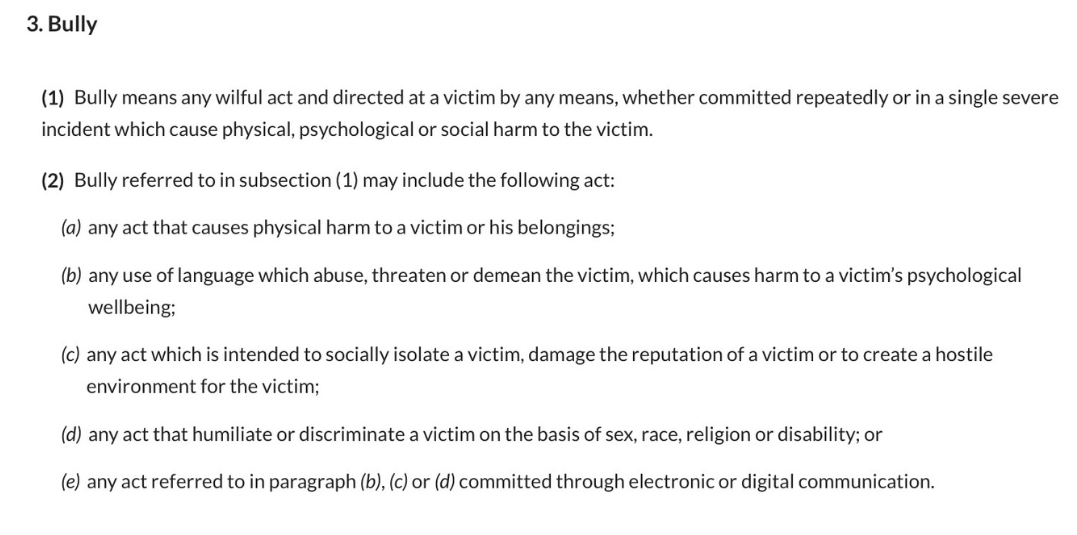
As per the above provision, the law covers:
- Physical Harm: Hurting a victim’s body or damaging and destroying their personal property
- Psychological/Verbal Harm: Using abusive, threatening, or demeaning language meant to cause severe mental distress
- Social Harm: Purposely leaving someone out, destroying their reputation, or creating a hostile environment
- Discriminatory Conduct: Bullying or humiliating someone based on their race, religion, sex, or disability
- Cyberbullying: Harassment carried out online or through messaging apps. To trace anonymous accounts, the tribunal works directly with the Malaysian Communications and Multimedia Commission (MCMC)
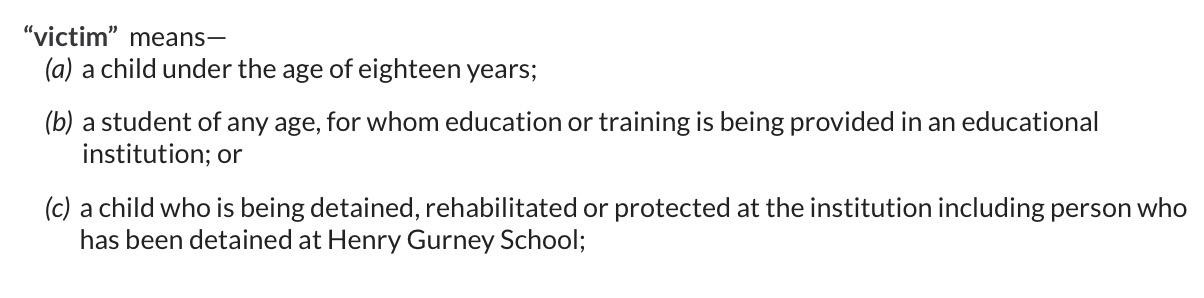
Furthermore, Section 2 of the Act below defines a “victim” as:
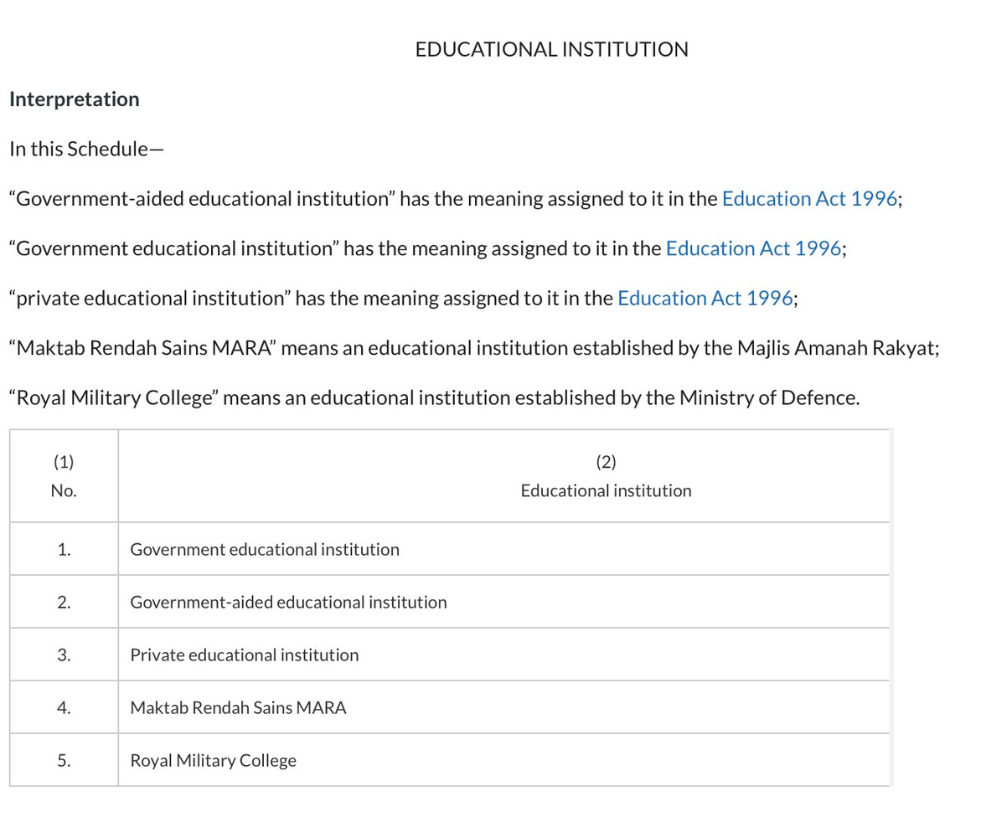
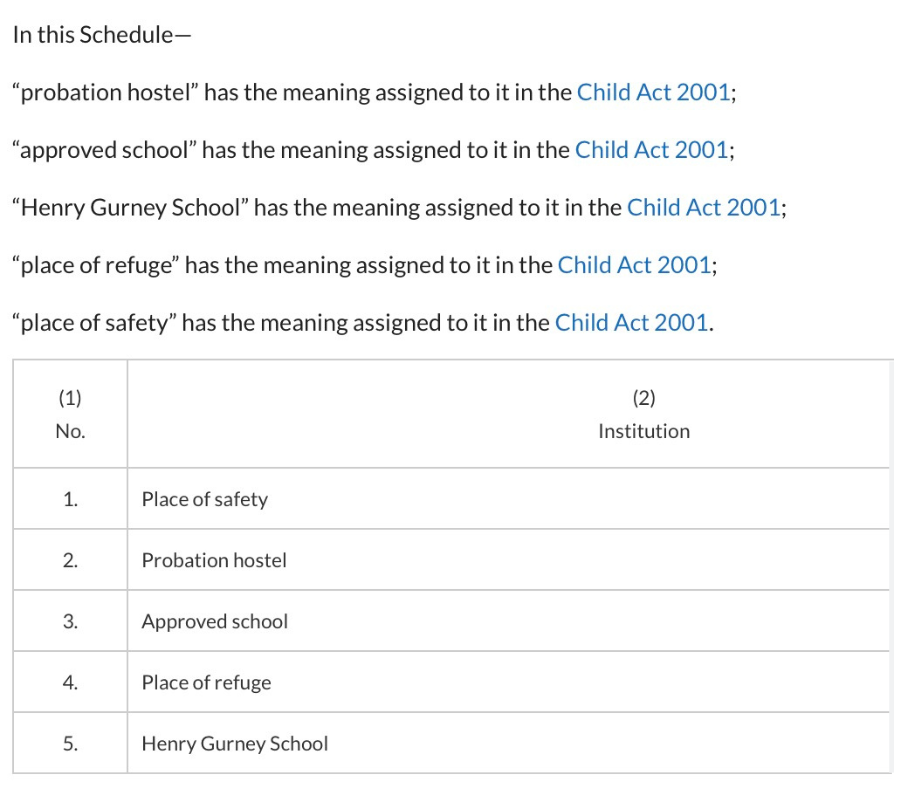
Besides that, as per the First and Second Schedules, the jurisdiction covers government, government-aided, and private schools, Maktab Rendah Sains MARA (MRSM), the Royal Military College (RMC), as well as places of safety, probation hostels, approved schools, and places of refuge.
It is worth noting that while the law currently focuses on minors, Azalina clarified that the government keeps the door open to expanding its scope to cover adults in the future. As it is now, the law is not applicable for bully cases in institutions of higher learning. For example, if a bullying incident took place at Universiti Pertahanan Nasional Malaysia (UPNM), only relevant provisions under the Penal Code would be applicable.
What Schools Must Do

The law enforces strict statutory rules on educational and rehabilitation facilities long before a case ever reaches the tribunal stage. Under Parts III to VI of the Act, all public, private, MARA, defence, and welfare institutions are required by law to implement protective mechanisms to oversee, prevent, and manage bullying complaints.
Administrators must ensure that their institutions meet the following benchmarks:
- Implement the policies, guidelines, and procedures determined by the respective Ministers or Majlis
- Establish an accessible, child-sensitive, and strictly confidential reporting channel for any student or child to report bullying cases
- Maintain a dedicated internal committee to receive, handle, and conduct mediation for bullying complaints
- Establish and provide counselling services and psychosocial support
While internal institutional processes remain the primary line of defence, these committees are explicitly permitted to bypass mediation. Under Sections 8(3), 13(3), 17(3), and 24(3), the committee may directly refer the complaint to the Tribunal, subject to obtaining the complainant’s informed consent.
How the Anti-Bullying Tribunal works
Should an institution fail to act, or if a case meets specific statutory limits, Part VII of the Act gives the Anti-Bullying Tribunal the power to take over and handle the dispute.
Structure and Neutrality
- Composition (Sections 25 and 26): The Tribunal for Anti-bully is established under the law. It is led by a President and a Deputy President appointed from the officers of the Judicial and Legal Service, alongside a panel of at least 10 other members who are legal practitioners with a minimum of seven years’ standing or experts in child psychology, development, and restorative justice
- Sittings (Section 35): Panels consist of three members, led by a legal Chairperson and two child/psychology specialists, and must include at least one woman
- Disqualification (Section 27): Members face immediate disqualification if they are adjudged bankrupt, certified mentally or physically incapable, engage in conflicting employment, bring discredit to the tribunal, or are convicted of fraud, corruption, or serious criminal charges
- Administration (Section 28): Legally appoints a Secretary and necessary staff to manage claims and furnish anonymised statistical data to the Human Rights Commission of Malaysia (SUHAKAM)
When Can the Tribunal Step In?
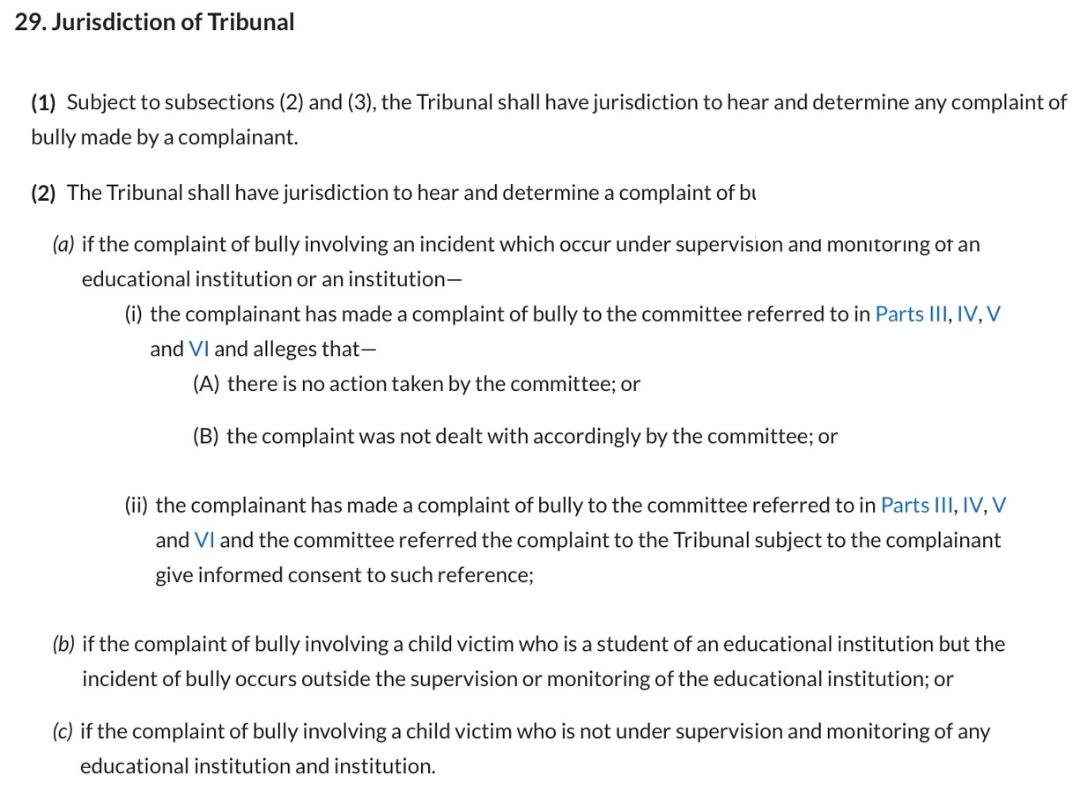
As detailed in Section 29, the body has strict statutory power to hear and determine a complaint of bullying only under specific legal circumstances:
- Failed Institutional Oversight: If the incident occurred under the monitoring of an educational institution or welfare facility, a complaint must have first been made to the internal committee. The tribunal steps in only if the committee takes no action, handles the complaint improperly, or refers the case directly with the complainant’s informed consent
- Off-Grounds Incidents: If the complaint involves a child victim who is a student of an educational institution, but the incident of bullying occurs completely outside the supervision or monitoring of that institution
- Unaffiliated Minors: If the complaint involves a child victim who is not under the supervision and monitoring of any educational institution or welfare facility
Proceedings and Safeguards
Determination of Rules and Procedures
To preserve the psychological safety of minors, the Act highly regulates the environment of a Tribunal trial. Under Section 31(4), all proceedings involving a child must be conducted in an informal and child-friendly manner, prioritising the child’s best interests and capability to understand and give evidence.
To protect children during hearings, Section 31(4)(d) authorises the Tribunal to employ explicit protective measures:
- Allowing child witnesses to give evidence via a live link or other appropriate electronic means
- Arranging for the use of protective physical screens or other arrangements
- Appointing an intermediary, psychologist, disability specialist, or other suitable expert to assist the panel in communicating clearly with the child
The Tribunal evaluates complaints on the civil standard of a balance of probabilities. It exercises full statutory powers to issue interlocutory orders, manage the admissibility of evidence, administer oaths, and issue enforceable summonses to compel the attendance of parties or witnesses.
Sittings, Representation and Privacy
- Electronic Hearings (Section 33): The Tribunal is legally empowered to conduct hearings wholly or partly by electronic means if appropriate, provided it takes concrete steps to preserve child privacy, data confidentiality, and a fair opportunity to be heard
- Restriction on Lawyers (Section 36): To maintain a low-stress environment, no party is permitted to be represented by an advocate and solicitor during a hearing. Lawyers are barred by default unless the Tribunal decides the case involves highly complex issues of law. Unrepresented children can be referred for state legal aid, and children retain the absolute right to be accompanied and assisted by a parent or guardian
- Privacy Controls (Sections 37 and 50): All hearings are strictly closed to the public. Section 50 imposes a strict ban on publishing or transmitting any media details through any electronic medium that could lead to the identification of a child involved, penalising media leaks with fines up to RM50,000.00, two years’ imprisonment, or both
Remedies, Parental Liability, and Criminal Penalties
Binding Awards and Orders
The Tribunal is legally mandated to deliver its final award without delay, and where practicable, within 60 days from the first day the hearing commences.
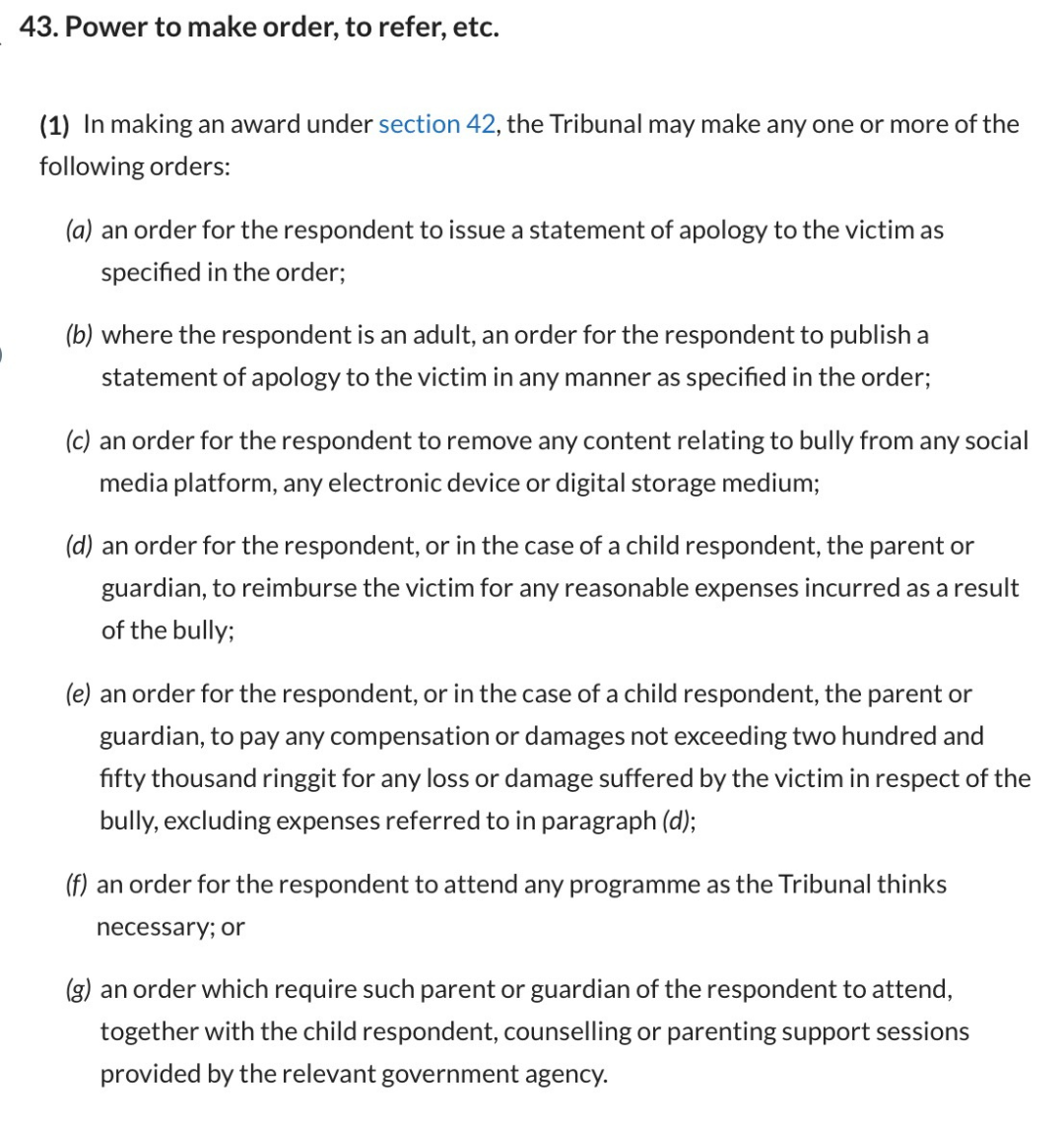
Under Section 43, if a respondent is found responsible for bullying, the Tribunal can issue powerful, legally binding awards. Notably, the provision prescribes joint liability, whereby if the perpetrator is a child, the financial and compliance orders extend directly to their parents or guardians.
The remedies can include:
- Restorative Orders: Forcing the respondent to issue a statement of apology to the victim, or ordering the immediate removal of bullying content from any social media platform and digital storage devices
- Parenting Support Orders: Requiring the parent or guardian of the respondent to attend mandatory counselling or parenting support sessions provided by the relevant government agency alongside the child respondent
- Compensatory Damages: Ordering the respondent, or the parents/guardians if the bully is a child, to reimburse the victim for reasonable expenses and pay additional compensation or damages for loss or injury up to a statutory maximum cap of RM250,000
Criminal Non-Compliance Penalties
An award handed down by the Tribunal is final, binding, and legally deemed to be an order of a standard court of law. However, unlike traditional civil judgements, Act 876 gives its awards immediate criminal teeth if a family ignores them.
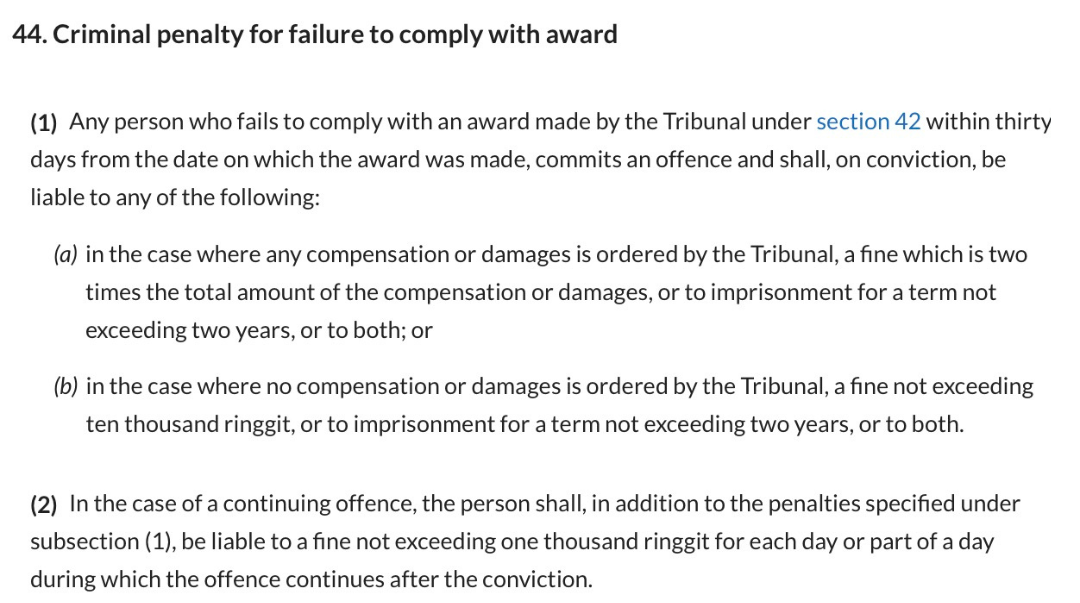
Under Section 44, if an individual or responsible parent fails to comply with a Tribunal award within 30 days, they commit a criminal offence. Upon conviction in a standard criminal court, the penalties are uncompromising:
- For monetary award breaches: If a parent refuses to pay the ordered compensation, they face a criminal fine equal to two times the total amount of the compensation, a prison term not exceeding two years, or both
- For non-monetary award breaches: If a party ignores rehabilitation or parenting support class orders, they face a fine not exceeding RM10,000, a prison term not exceeding two years, or both
- For continuing offences: An additional daily fine of up to RM1,000 per day for each day or part of a day during which the offence continues after the initial criminal conviction
Importantly, Section 54 guarantees that a civil complaint brought under this Act does not preclude a complainant from simultaneously lodging a standard police report to pursue separate criminal charges under any written laws.

With the full implementation of Act 876, the Government is effectively shifting the primary burden of monitoring child behaviour from the classroom back to the living room. By establishing clear parental liability under Section 43, and backing it up with immediate criminal records, double-damages fines, and potential prison time under Section 44 for non-compliance, Malaysia has drawn an uncompromising line in the sand: if your child refuses to stop bullying, you will be the one paying the price.

For more insights into the Malaysian legal system such as this, do make sure to follow us on Facebook and Instagram or visit our official website. You can also read our articles on the popular Malaysian news aggregator app Newswav here.